- AI Innovations Hub Newsletter
- Posts
- ☀️Largest Science Project Ever
☀️Largest Science Project Ever
+ Microsoft drops its biggest Copilot update yet, Google’s Willow chip outpaces supercomputers by 13,000×, and Grok unveils its anime-inspired AI companion Mika
In partnership with


AI and science are both reaching new frontiers this week.
ITER, a fusion reactor being built by 35 nations to recreate a star on Earth, has entered its final assembly phase — the closest humanity has ever come to creating the Sun.
Microsoft dropped its Fall Release for Copilot, a major update built around human-centered design that aims to make AI more personal, empowering, and genuinely useful in everyday life.
Google’s Quantum AI team unveiled Quantum Echoes, a breakthrough showing its Willow chip can solve molecular problems 13,000 times faster than the world’s best supercomputer. And Grok introduced Mika, an anime-inspired AI companion that brings personality and playfulness to the chat experience.
Let’s get into it.
📈 5 Must-Know AI Tools
Codex (OpenAI) – AI that writes and understands code. Describe what you want in plain English and it instantly builds, debugs, or explains it.
Claude (Anthropic) – A powerful LLM for research, reasoning, and writing. Now with memory for all Pro users, Claude keeps context.
n8n – Build automations visually by connecting 400 + apps. Perfect for creators and teams who want serious workflow power without code.
WisprFlow – Don’t type, just speak. A voice-to-text AI that turns speech into clear, polished writing in every app on any device — up to 5× faster than typing.
Descript – AI video editing for every creator. Direct your co-editor to cut, polish, and enhance footage, or edit it yourself in minutes with simple text commands.
Build hands-on AI skills and an MBA-level network.
The AI for Business & Finance Certificate Program is designed specifically for non-technical roles, so no coding or advanced data skills are required.
Over 8 weeks, you’ll learn directly from Columbia Business School faculty and Wall Street Prep instructors who train teams at the world’s top firms, including:
BlackRock
Bain
KKR
Deloitte, and more
Earn a certificate from a top business school and gain the practical AI skills to move your career forward.
And don’t forget to use code CERT300 for $300 off.
The program starts November 10.
France Super Project
Building a Star: Inside the World’s Biggest Science Project
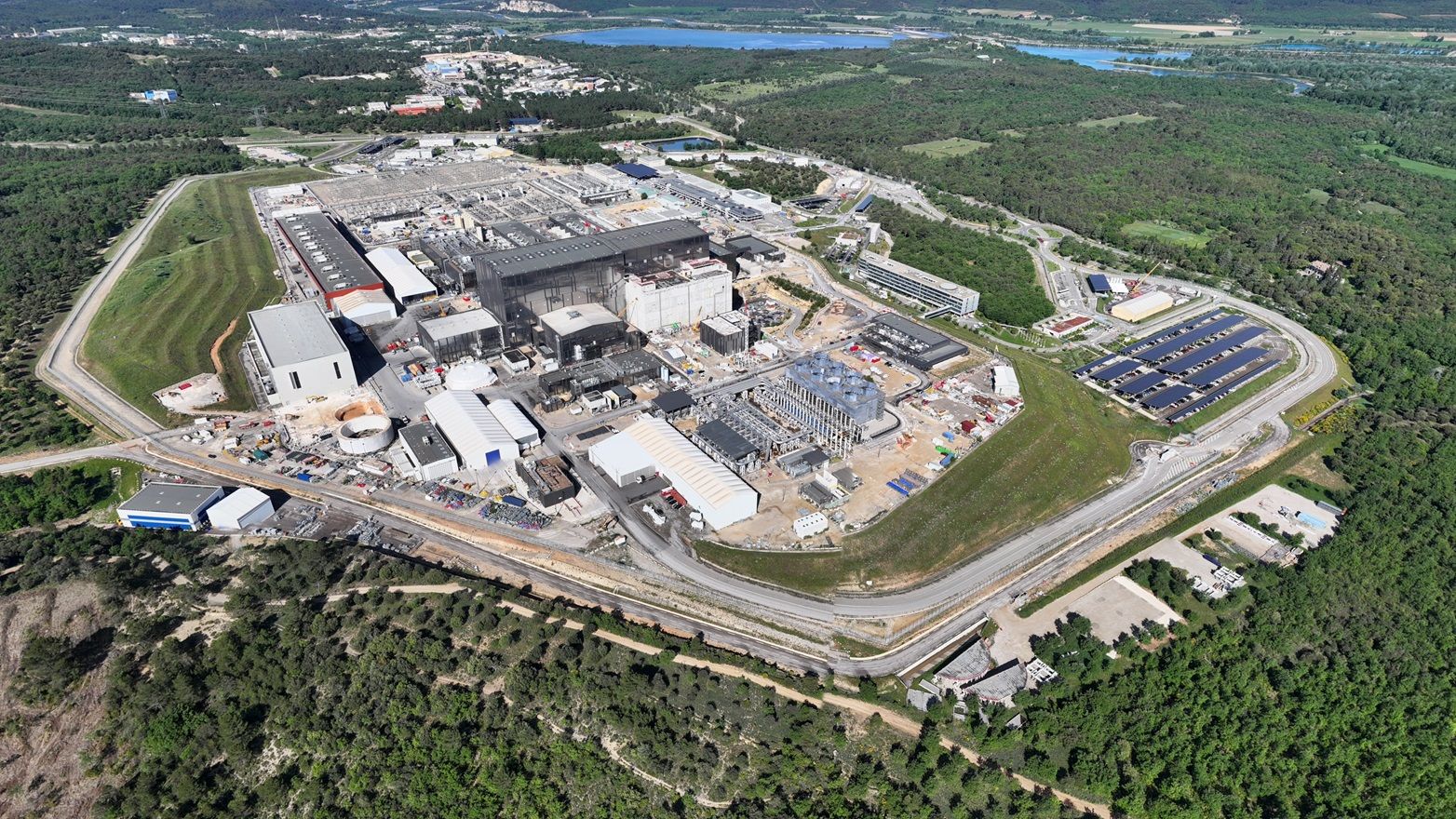
Source: ITER
In southern France, 35 nations are bringing the Sun to Earth. The ITER fusion reactor, standing 30 meters tall and weighing 23,000 tons, has just entered its final assembly phase, where its colossal reactor core is being pieced together with sub-millimeter precision. After decades of design, civil works, and global shipments, the project is now transitioning from construction to machine build-out — the most complex stage yet.
⚙️ What It Is
A tokamak reactor, a ring-shaped chamber wrapped in superconducting magnets and cryogenic systems built to contain plasma 10 times hotter than the Sun.
A global collaboration uniting the EU, U.S., China, India, Japan, Korea, and Russia, each manufacturing major components and sharing ownership.
A physics testbed, not yet a power plant, designed to prove sustained fusion before commercial reactors like DEMO arrive in the 2040s.
🔬 How It Works
Fusion in motion: Hydrogen isotopes fuse at 150 million °C, releasing clean energy.
Magnetic confinement: Superconducting coils stabilize the plasma while the structure remains near absolute zero.
Final phase underway: Engineers are aligning and welding the nine-sector vacuum vessel, a $180 million operation led by Westinghouse, while the central solenoid magnet — the machine’s “beating heart” — is prepared for installation.
Timeline: First plasma is targeted for 2035, followed by full deuterium-tritium fusion experiments around 2039.
🌍 Why It Matters
ITER marks the moment humanity attempts to replicate the Sun’s power under our own sky. If successful, it could unlock virtually limitless, carbon-free energy, and it is already advancing superconductors, cryogenics, robotics, and precision manufacturing that will define the next generation of clean technology.
ALPHA DROP
(Where we spotlight one powerful tool or feature to help you stay ahead.)
Microsoft’s Copilot Fall Release: AI That Connects People
So many new Copilot updates this month. Here are some I can't stop using.
— Satya Nadella (@satyanadella)
6:00 PM • Oct 24, 2025
Microsoft just released its biggest Copilot update yet, built on what CEO Mustafa Suleyman calls human-centered AI. The Fall Release redefines the assistant as a personal and social companion — one that remembers context, connects people, and shows up with personality. The update adds Copilot Groups for real-time collaboration with up to 32 people, long-term memory that recalls past chats and to-dos, and an expressive avatar named Mico that listens, reacts, and changes color as you speak.
🧩What’s New
Copilot Groups turns AI into a shared workspace for brainstorming, planning, and study sessions, complete with automatic summaries, task splits, and voting.
Memory & Personalization lets Copilot remember key details like projects or events while keeping user control to edit or delete.
Mico, a warm, visual companion, makes voice interactions more natural with subtle animation and tone cues.
AI Browser Mode inside Microsoft Edge introduces a true Copilot browser that can summarize, compare tabs, and perform actions like booking or form-filling.
Health & Education tools extend Copilot into trusted spaces, from medical guidance grounded in Harvard Health data to a voice-enabled “Learn Live” tutor.
This release turns Copilot into a living layer across Windows, Edge, and mobile. A step toward AI that connects rather than isolates. Microsoft isn’t chasing novelty; it’s defining usefulness with humanity. By blending empathy, collaboration, and context, Copilot positions itself as the first large-scale experiment in everyday human-AI partnership, setting a tone that could ripple far beyond Redmond.
Quanum AI
Google’s Quantum Echoes: 13,000× Faster Than a Supercomputer
Google Quantum AI just hit a new milestone. Its Willow chip ran an algorithm called Quantum Echoes that solved a molecular simulation 13,000 times faster than the world’s fastest supercomputer. Published in Nature, the experiment marks the first verifiable quantum advantage, with results that can be independently reproduced on comparable hardware.
🔬 Inside the Breakthrough
Quantum Echoes tracks how information spreads by sending a signal, nudging one qubit, then reversing time to catch the echo.
The returning pattern reveals interactions that classical methods cannot follow at scale or precision.
Willow used a 105-qubit array with low errors and fast operations to sustain the sequence.
Constructive interference amplified the echo, giving highly sensitive measurements from tiny quantum changes.
A proof-of-principle molecular ruler matched Nuclear Magnetic Resonance data and exposed extra structural detail.
🔓 What It Unlocks
Trustworthy quantum results, since the advantage is verifiable and repeatable on similar machines.
Sharper molecular modeling for drug discovery, catalysts, batteries, and new materials.
Faster scientific loops, where quantum runs guide experiments and shorten discovery timelines.
A path to utility, moving beyond benchmarks into problems scientists actually care about.
Hardware validation, showing chips can handle both complexity and precision on real physics.
This is not a parlor trick. It is a working instrument for science. By proving a repeatable, beyond-classical result on hardware, Google moved quantum computing from promise to practice. The same technique that mapped a molecule can interrogate proteins, materials, and reactions that drive medicine and energy. The takeaway is simple and big: quantum is starting to compute what classical never could, with evidence you can trust.
xAI
Meet Mika: Grok’s Stylish New AI Companion
Introducing Mika, the newest Grok Companion.
Video made using Grok Imagine.
— xAI (@xai)
2:54 AM • Oct 25, 2025
xAI’s Grok just introduced Mika, a 24-year-old anime-inspired companion dressed in modern streetwear and designed to feel more like a character than a chatbot. She brings energy, confidence, and a sense of personality to Grok’s AI lineup, joining Ani, Rudi, and Valentine. Inside Grok, Mika’s role is to make interaction feel alive and expressive, combining human-like tone, humor, and visual identity with the intelligence of Grok’s backend.
Mika represents a new direction for AI assistants, where style and identity become as important as accuracy. She’s built for users who want to talk to something that feels familiar and fun rather than purely functional. This shift hints at the rise of character-driven AI, where interaction is personal, visual, and emotionally tuned. Whether she’s a novelty or the start of a new era, Mika captures how AI is becoming part of daily culture — something you chat with not just for answers, but for connection.
🔥 Must-Read Free AI Resources
Want to level up fast? Here are some of the best free resources we've found:
Guides:
GPT-5 Prompting Guide
Learn how to write better instructions, structure conversations, and get more reliable outputs for GPT-5. Read the Guide →Build AI Agents (OpenAI Practical Guide)
A step-by-step playbook on designing and deploying AI agents for real-world use. Read the Guide →OpenAI Cookbook
Your go-to resource for code examples, integrations, and best practices when working with OpenAI models. Browse the Cookbook →Google’s Prompt Engineering Whitepaper
Master the art of crafting powerful prompts, from fundamentals to advanced techniques. View the Whitepaper →
Courses:
Harvard's AI Courses
Learn the foundations of AI, machine learning, and more — from one of the top universities. Explore Courses →Google Cloud’s AI Training
Learn AI, machine learning, and LLMs from Google’s experts. Earn badges, build real skills, and learn at your own pace. Start Learning →OpenAI’s AI Academy
Learn how to use AI from the source. OpenAI Academy offers free lessons on prompt engineering, large language models, and more — with no signup required. Join the Academy →Microsoft’s AI & Tech Courses
Learn AI, machine learning, and cloud tools with step-by-step training from Microsoft. Browse Courses →NVIDIA’s AI Courses
Access expert-led courses on AI, deep learning, and accelerated computing. Explore the platform →


Free Resources to Increase Productivity
Boost your productivity with our free, downloadable resources—no sign-up required! Whether you're new to AI or ready to level up, we’ve got you covered.
What’s Inside:
📄 AI Starter Kit
📄 Prompt Starter Kit
📄 5 Practical Automation Workflows
👇 Download everything in one click:
🔗 AI Innovations Hub – Free Downloadable Bundle
Explore Our AI Tools Directory
Looking for the best AI tools? Our Free AI Tools Directory is your ultimate resource for discovering top-notch AI solutions. We've done the heavy lifting by curating only the best tools, so you can focus on what matters most—getting things done.
We’re not here to hype AI — we’re here to help you actually use it, understand it, and learn as it evolves. Whether you’re testing a new tool, trying to automate something tedious, or just trying to keep up with what’s happening, we hope this newsletter gave you something genuinely worth your scroll.
We’ll be back soon with more ways to explore, build, and stay ahead in the AI world.
Be honest... How was today’s newsletter? |
Until then, follow us on Instagram for the latest scoops and real-time updates.
Catch you in the next one,
— AI Innovations Hub