- AI Innovations Hub Newsletter
- Posts
- 🚀Google's Building Data Centers in Space
🚀Google's Building Data Centers in Space
+ Create polished presentations from one prompt, AI robot built for your home, and see why Coca-Cola’s Christmas ad is sparking debate again
In partnership with


Earth might be running out of room for AI, so Google is looking up.
Its new Project Suncatcher aims to build solar-powered data centers in space that could one day run massive machine learning systems off sunlight alone. Google also gave Gemini Canvas the ability to create entire presentations from a single prompt, turning rough notes into polished client-ready decks in seconds.
Meanwhile, robotics firm 1X opened preorders for NEO, a five-foot-six home AI robot built to carry, clean, and lend a helping hand around the house. And Coca-Cola’s annual Christmas ad is once again AI-generated, turning a decades-old holiday tradition into a fresh debate about where creativity ends and automation begins.
Let’s get into it.
📈 5 Must-Know AI Tools
MapsGPT – Type in any idea (like “best rooftop bars in NYC”) and this AI instantly builds a custom interactive map. Perfect for trip planning, events, or local guides.
Talkpal – Talk your way to fluency. This AI tutor chats with you in real time to sharpen your speaking, listening, and grammar in 50+ languages.
Lux Algo – Backtest smarter with AI. Lux’s assistant lets you request strategies in plain language and simulate over 6 million setups across crypto, stocks, forex, and more.
YouLearn AI – Upload any lecture, slide, or video — get instant summaries, takeaways, and quizzes tailored to how you learn.
Humva – Turn scripts into studio-quality videos using hyper-realistic AI avatars—no actors, no cameras, just pure prompt magic.
How can AI power your income?

Ready to transform artificial intelligence from a buzzword into your personal revenue generator
HubSpot’s groundbreaking guide "200+ AI-Powered Income Ideas" is your gateway to financial innovation in the digital age.
Inside you'll discover:
A curated collection of 200+ profitable opportunities spanning content creation, e-commerce, gaming, and emerging digital markets—each vetted for real-world potential
Step-by-step implementation guides designed for beginners, making AI accessible regardless of your technical background
Cutting-edge strategies aligned with current market trends, ensuring your ventures stay ahead of the curve
Download your guide today and unlock a future where artificial intelligence powers your success. Your next income stream is waiting.
Building AI Data Centers in Space
Our TPUs are headed to space!
Inspired by our history of moonshots, from quantum computing to autonomous driving, Project Suncatcher is exploring how we could one day build scalable ML compute systems in space, harnessing more of the sun’s power (which emits more power than 100
— Sundar Pichai (@sundarpichai)
5:01 PM • Nov 4, 2025
Google is turning AI compute into a space mission. Project Suncatcher aims to place solar-powered satellites loaded with Trillium TPUs into orbit, linking them together with laser connections to act like one data center in space. Up there, solar panels generate up to eight times more energy than on Earth and stay lit almost nonstop. The first prototypes launch with Planet in early 2027.
👁️ What It Is
A cluster of small satellites running TPUs that share data through light beams instead of cables.
Each satellite harvests constant sunlight in a dawn-to-dusk orbit, cutting the need for heavy batteries.
Trillium chips survived five-year radiation simulations with no core damage, proving they can run reliably off-planet.
The mission tests whether compute can scale beyond Earth’s grid using renewable energy straight from the Sun.
🧩 How It Works
Laser data links: early demos reached 1.6 terabits per second between two satellites.
Close formation flight: craft orbit just hundreds of meters apart to keep those beams aligned.
Autonomous control: orbital stability modeled with JAX physics tools to coordinate dozens of satellites.
Cooling in vacuum: heat leaves through large radiators while onboard redundancy handles any hardware failure.
⚙️ What’s Next
Two prototypes in 2027 will test real TPU hardware and optical networking in orbit.
Falling launch costs could make space compute cost-competitive if prices dip below $200 per kilogram.
Remaining hurdles: cooling efficiency, high-speed ground links, and long-term reliability in orbit.
💡 Why It Matters: Google is building the blueprint for off-Earth AI infrastructure: a self-powered compute network that runs on sunlight and empty space. The work could redefine how far energy and processing can scale, setting up new industries in orbital computing, laser communications, and chip design built for radiation and isolation. The 2027 launch will mark the first test of whether machine learning can truly leave the planet.
👉 Read Google Research’s full post on Project Suncatcher for visuals and technical details.
ALPHA DROP
(Where we spotlight one powerful tool or feature to help you stay ahead.)
Gemini Canvas Can Now Build Your Slides
Go from blank slide to polished presentation faster with Canvas in Gemini.
Now you can ask Gemini to “create a presentation” with a single prompt (and all your project notes). Try it out for yourself:
— Google Gemini App (@GeminiApp)
9:54 PM • Nov 3, 2025
Google just gave its AI a new creative studio. Inside Gemini Canvas, you can now type one prompt like “create a presentation” and watch it turn notes or documents into a complete slide deck — titles, layouts, and visuals included. What once took hours of formatting now happens in seconds, right inside Google’s AI workspace.
🎨 What It Can Do
Turn raw text or project notes into a finished presentation instantly.
Auto-generate slide titles, talking points, and visual layouts from a single command.
Import a Google Doc or pasted notes directly into Canvas for faster setup.
Export the result straight to Google Slides for final edits or collaboration.
Gemini now supports multi-modal prompting inside Canvas, combining text, images, and docs in one workspace.
You can request specific styles or tones (“minimalist pitch deck,” “research summary,” “team update”) and it adapts the layout,
Gemini is turning slide creation into a conversation. Instead of opening a blank deck, users describe what they need and get a ready-to-present version built around their content. It compresses the slowest creative task in work — presentation design — into a guided flow that blends writing, layout, and visuals. For creators, founders, and analysts, it’s another step toward AI-first productivity where ideas move as fast as you can type.
👉 Try it on Google Research’s Gemini Canvas to build your next deck from a single prompt.
1X
NEO: The Real-World Home Robot
NEO The Home Robot
Order Today— 1X (@1x_tech)
6:04 PM • Oct 28, 2025
A humanoid robot you can actually buy just arrived. NEO, from robotics company 1X, is a five-foot-six household assistant that can tidy, carry, and learn as it goes. It’s powered by advanced AI on Nvidia’s Jetson Thor processor, built for tasks that once belonged in science fiction. Early units are expected to roll out in 2026.
🔧 Inside the Build
Human-scale design: 5'6" tall with tendon-driven joints that mirror natural movement.
Price: about $20,000 to own or $499 per month subscription.
Soft exterior: covered in flexible fabric for safety and comfort around people.
Quiet operation: runs at about 22 decibels, similar to a whisper.
Runtime and power: roughly four hours per charge, self-docking to refuel.
Processing core: Nvidia Jetson Thor chip handling vision, motion, and on-device AI reasoning.
🏠 Everyday Use
Organizes and cleans surfaces, picks up clutter, and moves light items.
Opens doors and navigates through rooms without bumping into objects.
Follows spoken requests or app-scheduled routines.
Learns over time, improving through updates and guided teaching.
Functions as a mobile smart hub, connecting to your existing devices and music or reminders.
NEO takes the robot from the lab and puts it in the living room. It is an early test of whether AI can share human space, handling small chores while learning the rhythms of daily life. For many, it is the first glimpse of the future we have only seen in movies, an intelligent machine that actually helps at home.
👉 Learn more or order NEO on 1X’s official site.
AI Outrage
Coca-Cola’s AI Christmas Ad Sparks Mixed Cheers
Coca-Cola’s annual Christmas advert is AI-generated again this year.
The company says they used even fewer people to make it — “We need to keep moving forward and pushing the envelope… The genie is out of the bottle, and you’re not going to put it back in”
— DiscussingFilm (@DiscussingFilm)
10:12 PM • Nov 3, 2025
Coca-Cola has launched its 2025 “Holidays Are Coming” Christmas commercial once again using generative AI, signaling that this is now part of the brand’s creative strategy rather than a one-off experiment. According to the company’s global head of generative AI, Pratik Thakar, “we need to keep moving forward. AI lets us explore new storytelling methods, faster and at scale.” The ad was produced with fewer people this year and pushed out in roughly one month rather than the year-long timeline of traditional productions.
Critical reaction has been mixed: some viewers appreciated improvements over last year—like more realistic truck wheels—while others criticized the ad for lacking the warmth and human touch of earlier campaigns. Industry observers highlight the broader tension the spot represents: brands’ drive to lean into AI for cost and speed, weighed against the risk of losing emotional resonance and the craftsmanship of human-led creative work.
The Simplest Way To Create and Launch AI Agents
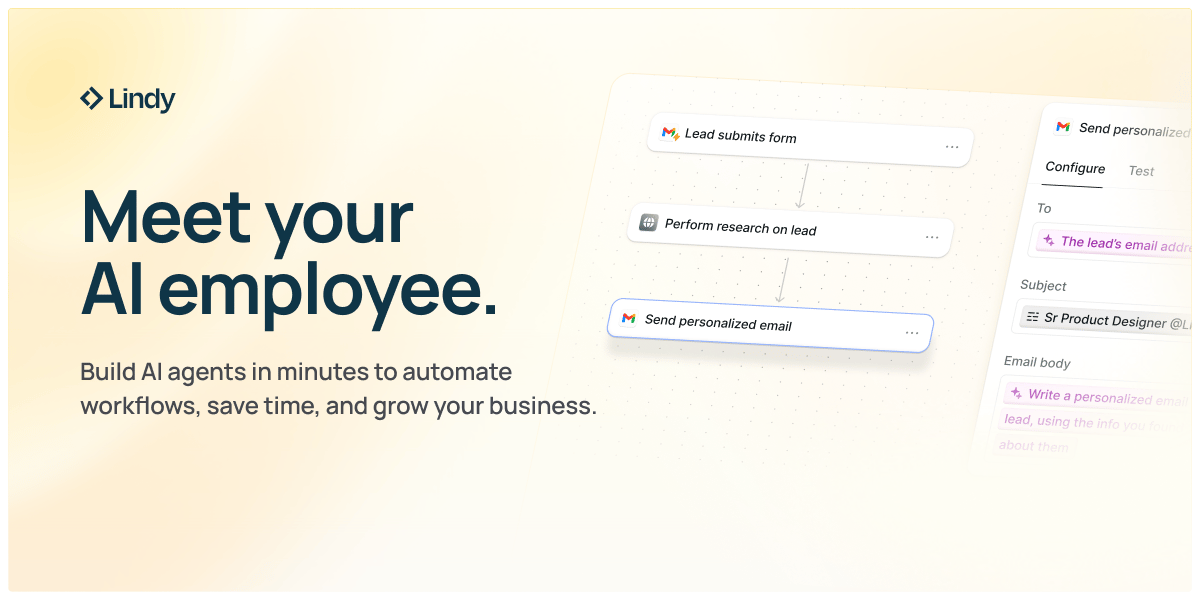
Imagine if ChatGPT, Zapier, and Webflow all had a baby. That's Lindy.
With Lindy, you can build AI agents and apps in minutes simply by describing what you want in plain English.
From inbound lead qualification to AI-powered customer support and full-blown apps, Lindy has hundreds of agents that are ready to work for you 24/7/365.
Stop doing repetitive tasks manually. Let Lindy automate workflows, save time, and grow your business.
🔥 Must-Read Free AI Resources
Want to level up fast? Here are some of the best free resources we've found:
Guides:
GPT-5 Prompting Guide
Learn how to write better instructions, structure conversations, and get more reliable outputs for GPT-5. Read the Guide →Build AI Agents (OpenAI Practical Guide)
A step-by-step playbook on designing and deploying AI agents for real-world use. Read the Guide →OpenAI Cookbook
Your go-to resource for code examples, integrations, and best practices when working with OpenAI models. Browse the Cookbook →Google’s Prompt Engineering Whitepaper
Master the art of crafting powerful prompts, from fundamentals to advanced techniques. View the Whitepaper →
Courses:
Harvard's AI Courses
Learn the foundations of AI, machine learning, and more — from one of the top universities. Explore Courses →Google Cloud’s AI Training
Learn AI, machine learning, and LLMs from Google’s experts. Earn badges, build real skills, and learn at your own pace. Start Learning →OpenAI’s AI Academy
Learn how to use AI from the source. OpenAI Academy offers free lessons on prompt engineering, large language models, and more — with no signup required. Join the Academy →Microsoft’s AI & Tech Courses
Learn AI, machine learning, and cloud tools with step-by-step training from Microsoft. Browse Courses →NVIDIA’s AI Courses
Access expert-led courses on AI, deep learning, and accelerated computing. Explore the platform →


Free Resources to Increase Productivity
Boost your productivity with our free, downloadable resources—no sign-up required! Whether you're new to AI or ready to level up, we’ve got you covered.
What’s Inside:
📄 AI Starter Kit
📄 Prompt Starter Kit
📄 5 Practical Automation Workflows
👇 Download everything in one click:
🔗 AI Innovations Hub – Free Downloadable Bundle
Explore Our AI Tools Directory
Looking for the best AI tools? Our Free AI Tools Directory is your ultimate resource for discovering top-notch AI solutions. We've done the heavy lifting by curating only the best tools, so you can focus on what matters most—getting things done.
We’re not here to hype AI — we’re here to help you actually use it, understand it, and learn as it evolves. Whether you’re testing a new tool, trying to automate something tedious, or just trying to keep up with what’s happening, we hope this newsletter gave you something genuinely worth your scroll.
We’ll be back soon with more ways to explore, build, and stay ahead in the AI world.
Be honest... How was today’s newsletter? |
Until then, follow us on Instagram for the latest scoops and real-time updates.
Catch you in the next one,
— AI Innovations Hub